Free tool
The Feelings Wheel: An Interactive Emotion Wheel
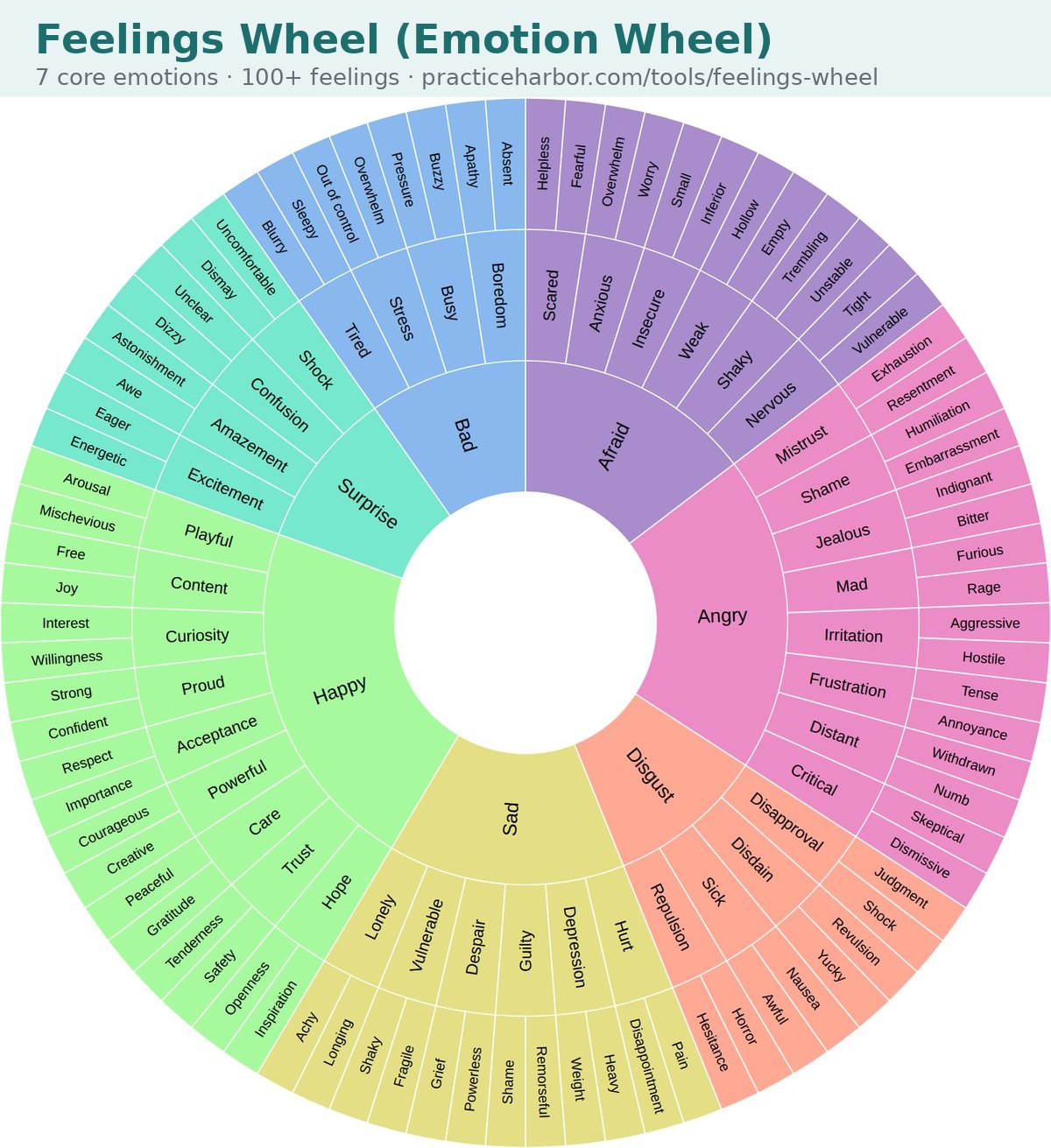
One of the challenges in learning to communicate is knowing what you feel. Here is a feelings wheel for when you don't know what to say: start at the center with a core emotion, then move outward until a word fits. Click or tap the words that resonate — the wheel will build your "I feel…" statement below. Prefer words to wedges? Every word is also in a browsable list with definitions further down.
Private by design: everything happens on this page. Nothing you click is sent or stored anywhere.
On a phone, the outer-ring words run small — the word list below the wheel may be easier.
I feel…
Tip: naming a feeling precisely is itself regulating — psychologists call it "affect labeling."
Prefer a list? Browse all 100+ words, with definitions
Every word on the wheel, grouped from core emotion to most specific, each with a one-line definition. Selecting a word here does the same thing as clicking it on the wheel.
the body bracing for danger — real or remembered.
- alarm, with your attention locked on the threat.
- wanting to act, and finding nothing your hands can do.
- dread that keeps checking over its shoulder.
- revved and unsettled, scanning for what could go wrong.
- more coming in than you can hold.
- the mind circling the same what-if.
- unsure there’s solid ground under you.
- shrunk down, taking up less room than you actually do.
- measuring yourself against someone and coming up short.
- the strength drained out of your limbs.
- an empty space where something should be.
- nothing left to draw on.
- unsteady from the inside out.
- the shake you can feel in your hands.
- like the floor might tilt at any moment.
- keyed up, waiting for something to happen.
- muscles holding on, braced.
- soft and unguarded — easily reached, easily hurt.
heat rising to defend something that matters.
- guard up, waiting for the catch.
- run down past the point of caring.
- old anger kept warm and re-counted.
- wanting to disappear from view.
- shame with an audience.
- caught in a flush, wanting to look away.
- guarding something you fear losing to someone else.
- anger with your back straightened; the sense that a line was crossed.
- anger gone cold and settled in.
- plain heat, close to the surface.
- anger with the throttle open.
- anger past steering.
- a low scrape that keeps repeating.
- energy pushing forward, ready to collide.
- braced against someone, ready to fight.
- pushing hard against something that won’t move.
- wound tight, waiting to release.
- a small, repeated poke.
- pulled back behind glass.
- folded inward, away from contact.
- feeling switched off to stay safe.
- fault-finding as a way of keeping distance.
- not buying it, arms crossed.
- waving it away before it lands.
the whole body saying no to something.
- a no, with a shake of the head.
- sorting someone as wrong from a step above.
- a jolt that stops everything for a beat.
- looking down the nose, wanting distance.
- recoiling — the body pulling back fast.
- plain, childlike ick.
- wrongness felt in the stomach.
- the stomach turning over.
- bad all the way through.
- pushed away hard by every instinct.
- frozen by something you can’t unsee.
- a foot hovering, not ready to step.
the weight of losing or missing something.
- an ache where someone touched something tender.
- the raw signal itself, sharp or dull.
- the drop when the hoped-for doesn’t come.
- gray and heavy, hard to start anything.
- gravity turned up.
- carrying something you can’t set down.
- the gnaw of having done harm.
- guilt that wishes it could undo.
- wanting to disappear from view.
- the light at the end going out.
- no lever left to pull.
- love with nowhere to go.
- soft and unguarded — easily reached, easily hurt.
- one bump from breaking.
- unsteady from the inside out.
- an ache for company that isn’t there.
- reaching toward something out of reach.
- a dull hurt spread thin through the body.
warmth and lift; things feeling right.
- a small light up ahead.
- an idea that lifts you to your feet.
- gates unlatched, letting things in.
- resting your weight on someone and staying easy.
- shoulders down, no scanning needed.
- soft warmth toward something dear.
- leaning toward someone’s wellbeing.
- warmth for what has been given.
- still water inside.
- your own strength, felt and ready.
- something new wanting out through your hands.
- afraid, and moving forward anyway.
- letting what is be what is.
- mattering — taking up your rightful room.
- standing tall in someone’s regard.
- warmth at what you’ve done or who you are.
- sure-footed, no second-guessing.
- sturdy through the spine.
- leaning in, wanting to know.
- a quiet yes.
- attention that stays put on its own.
- enough, and knowing it.
- brightness that spills over.
- nothing pinning you down.
- light on your feet, ready for fun.
- playfulness with a glint in it.
- the body waking up, alive and stirred.
the world doing something you didn’t expect.
- sparks — energy rising toward something.
- charged up and ready to move.
- leaning toward what’s coming.
- stopped in your tracks by something big.
- feeling small in front of something vast — in a good way.
- eyebrows up, words gone.
- signals crossing; no clear picture.
- the room tilting slightly.
- fog where the answer should be.
- a jolt that stops everything for a beat.
- the sinking oh-no.
- something is off, and the body knows it.
off, low, or wrong in a way that’s hard to name.
- running low, needing rest.
- edges gone soft, hard to focus.
- the pull toward closing your eyes.
- carrying too much with the clock running.
- the wheel not answering your hands.
- more coming in than you can hold.
- full to the brim with doing.
- pressed from all sides to perform.
- static under the skin; can’t settle.
- under-fed attention — restless and flat.
- the caring switched off.
- here in body, gone in spirit.
For therapists and journalers: — handy for waiting rooms, groups, and session check-ins.
Why this wheel is different
Many popular emotion wheels mix feelings with stories about other people. When a person says "I feel disrespected," they are not actually naming a feeling — they are telling a story that someone is disrespecting them. Their actual feeling underneath could be almost anything: anger, sadness, even steely determination. This wheel is an attempt to stay closer to words that are actually felt in the body — so that when we share them, we are sharing something real.
Lineage
This wheel is Dr. Wong's revision of an adaptation by Mike Bostock of Geoffrey Roberts's Emotion Wheel (2015), which drew on Kaitlin Robbs's vocabulary wheel (2014), which in turn traces to The Feeling Wheel published by Dr. Gloria Willcox (1982). Feel free to use and adapt with credit.
Feelings wheel vs. emotion wheel
Most people use the two names for the same thing: a circle that starts with a few broad emotions in the middle and gets more specific toward the edge. "Feelings wheel" usually points back to Gloria Willcox's Feeling Wheel, and "emotion wheel" is the more general term. You will also see Robert Plutchik's wheel of emotions, which is a different model built around eight primary emotions and their intensities. It is often called an emotion wheel too.
This page is Practice Harbor's own wheel, with seven cores: Afraid, Angry, Disgust, Sad, Happy, Surprise, and Bad. It sits in the Willcox line through the adaptations listed above, but the word list has been revised so that it favors words you feel over words that describe what someone else did.
How adults use a feelings wheel
Adults often reach a wheel because the usual words have worn thin. "Stressed," "fine," and "upset" cover a lot of ground, and a wheel helps you find the one that fits better. A few common uses:
- Journaling. Pick one core, then one or two outer words, and write a sentence about when you first noticed it today. Over a few weeks, patterns show up.
- Before a hard conversation. Anger is often the first word that comes up. Checking the wheel can show you something softer next to it, like hurt or disappointment, which is often easier for the other person to hear.
- In therapy. Bringing a word or two to session gives you and your therapist a concrete place to start instead of a general sense that the week was bad.
- Naming to settle. Putting a precise word on a feeling can take some of the edge off. It does not make the feeling go away, but it often makes the next step clearer.
The anger section of the wheel
On this wheel, Angry opens into 8 middle-ring feelings, each with two finer words:
- Mistrust: exhaustion, resentment
- Shame: humiliation, embarrassment
- Jealous: indignant, bitter
- Mad: furious, rage
- Irritation: aggressive, hostile
- Frustration: tense, annoyance
- Distant: withdrawn, numb
- Critical: skeptical, dismissive
The finer words help separate intensity (annoyance and tense are a long way from furious and rage), direction (hostile and aggressive push outward, while withdrawn and numb pull away), and age (resentment and bitter describe anger that has been held for a while). Shame appears here and again under Sad, because it can feel hot and defensive or heavy and low.
The sadness and depression section
Sad opens into 6 middle-ring feelings. Depression is one of them, used here as a feeling word rather than a diagnosis:
- Hurt: pain, disappointment
- Depression: heavy, weight
- Guilty: remorseful, shame
- Despair: powerless, grief
- Vulnerable: fragile, shaky
- Lonely: longing, achy
These words help tell apart sadness about a specific loss (grief, disappointment, longing) from sadness that sits in the body without a clear cause (heavy, weight, achy), and sadness turned toward yourself (guilty, remorseful). The Bad core is worth a look too: tired, apathy, and absent often travel with low mood. If a low, heavy stretch lasts for weeks, that is a reason to talk with a professional, not only to find a word for it.
Detailed and printable version
For the detailed version, open the full word list above: all 100+ words, grouped from core to most specific, each with a one-line definition. For paper, use the , a landscape letter-size page that works for journaling, groups, and waiting rooms. After you pick words on the wheel, you can also download your filled-in wheel as an image.
Common questions
What is a feelings wheel and how do I use it?
A feelings wheel maps emotions from broad to specific: seven core emotions at the center, unfolding into 100+ precise feeling words at the edge. Start at the center with whichever core emotion is closest, then move outward until a word actually fits. On this page, click the words that resonate and the wheel builds your ‘I feel…’ statement for you.
How is this wheel different from other emotion wheels?
Many popular wheels mix feelings with stories about other people — ‘disrespected’ or ‘betrayed’ describe what someone did to you, not what you feel. Underneath, your actual feeling could be anger, sadness, or something else entirely. This wheel stays closer to words that are actually felt in the body, so when you share them you’re sharing something real.
Does naming a feeling actually help?
Yes — putting a precise word on an emotion tends to lower its intensity, something psychologists call ‘affect labeling.’ That said, a wheel can name what you feel, not tell you why you feel it, and it isn’t a substitute for therapy. If a feeling is persistent or getting in the way of your life, talking with a therapist is a good next step.
Can I print or download the feelings wheel?
Yes. You can download a printable blank wheel as a PDF — handy for waiting rooms, therapy groups, and journaling — or download your filled-in wheel as an image with your ‘I feel…’ statement written across the top. Both are created on your own device.
Is what I click private?
Yes. Everything happens on this page, in your browser — nothing you click is sent or stored anywhere, and the image you download is created on your own device.
What are the 7 core emotions on this wheel?
Afraid, Angry, Disgust, Sad, Happy, Surprise, and Bad. Each core opens into a middle ring of more specific feelings and then an outer ring of finer ones, for 100+ words in all.
Is this feelings wheel meant for adults?
Yes. The vocabulary is written for adults and teens, and every word has a short, plain definition. Some words, such as resentment, remorseful, or indignant, would be a stretch for young children, who usually do better with a smaller set of faces or colors.
Where is anger on the feelings wheel?
Angry is one of the seven cores. It opens into mistrust, shame, jealous, mad, irritation, frustration, distant, and critical, and each of those opens into two finer words, from annoyance and tense out to furious and rage.
Can a feelings wheel tell me if I am depressed?
No. Depression appears on this wheel as a feeling word under Sad, which is not the same thing as the clinical condition. If low mood, heaviness, or loss of interest has lasted for weeks or is affecting sleep, work, or relationships, talk with a therapist or doctor.
For therapists: how to start a therapy group — many group leaders open sessions with a feelings-wheel check-in.
Using it in session
The wheel helps whenever a client lands on "fine," "stressed," or "bad" and stops there. Screen share it and let the client start at the center with the broad emotion, then move outward until a word fits. Ask them to say the "I feel…" statement out loud, and notice whether a second, softer feeling sits under the first one.
It is useful for couples and family work, for clients with limited emotional vocabulary, and for teens who find it easier to point than to explain. As homework, ask the client to check the wheel once a day and bring back one word that surprised them. The printable blank wheel works well in groups and waiting rooms.
Documentation example
Client initially described feeling "annoyed" about the missed call; using a feelings wheel via screen share, client identified "hurt" and "lonely" beneath the anger. Discussed how leading with irritation affects partner's response.
Limits and cautions
- A word list names a feeling; it does not explain it. Follow the word with exploration.
- Clients with alexithymia or some neurodivergent clients may find abstract emotion words hard to connect to; pairing with the sensations wheel or body map can help.
- Emotion vocabulary varies across languages and cultures; ask what a word means to the client.
- Not a diagnostic or assessment instrument.
Read the guides
More free tools
Are you a therapist? Practice Harbor is an EHR built by a psychologist — with tools like this built into the client experience.
Start free — no credit cardLast updated